
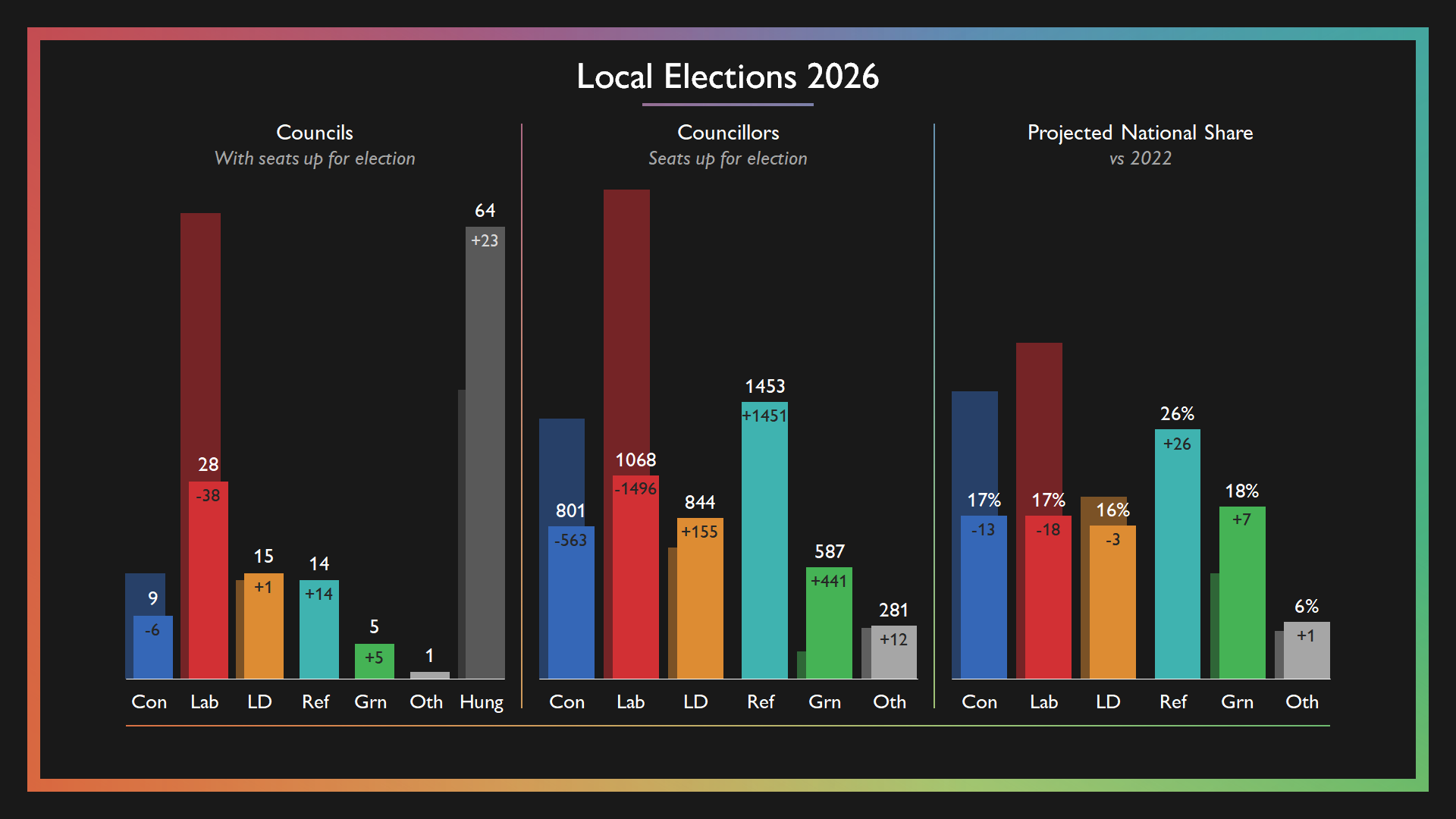
The 2026 local elections managed to be both seismic, with a net partisan churn of 41% of seats, the third highest in the post-war era, and somewhat unsurprising, the results were broadly as expected and strongly in line with the picture told in voting intention polls. Even more so than last year, the party system is fragmented and the traditional options are being rejected, patterns also seen in the elections for the Scottish Parliament and Welsh Senedd.
Prior to polling day, I produced a hopefully helpful cut-out-and-keep guide to assessing this year’s local elections, identifying the most useful metrics for measuring the results and giving some benchmarks for what certain outcomes would indicate for the parties. Now, with the results in, let’s take a first look at what the results show and how the parties shaped up on these various measures.
How did Labour do at the 2026 local elections?
Dreadfully.
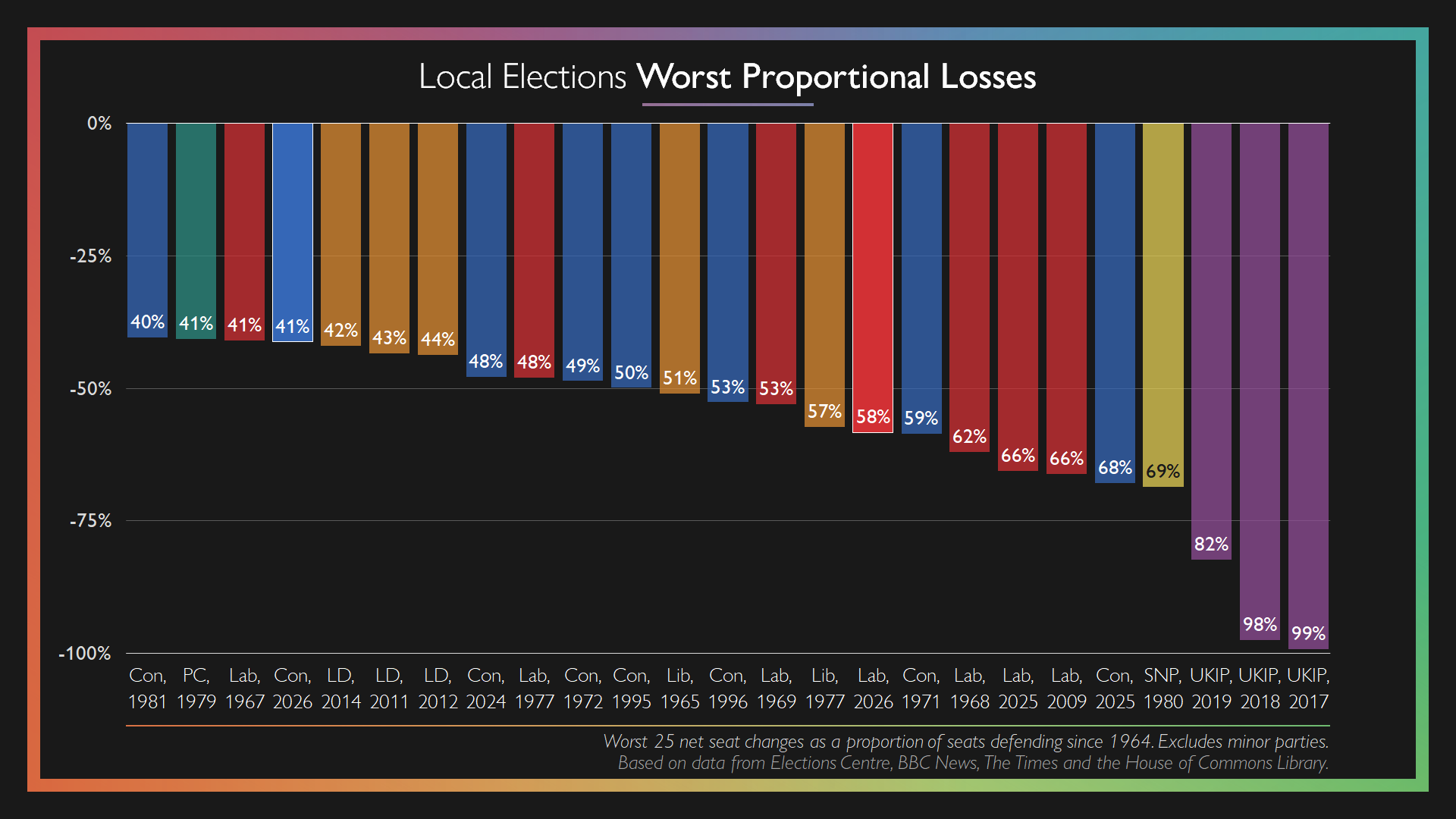
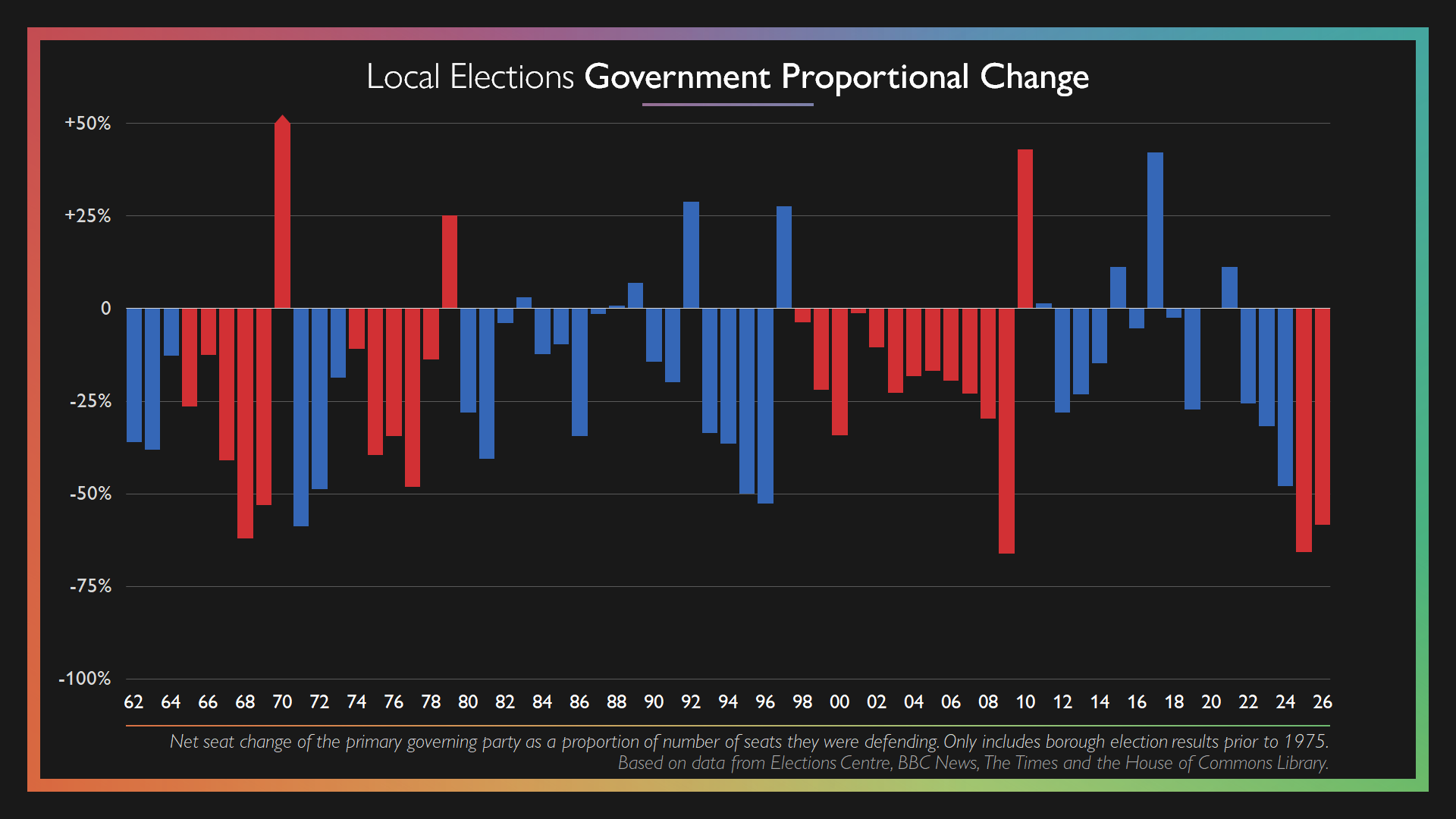
There’s not really a way around it, things went badly. Labour lost 58% of the seats it was defending, the fifth worst such rate for a government in the post-war period and the tenth worst for any significant party. It might not be as deep a cut as last year or in 2009, when Labour lost 66% of their seats, but it is greater than the 48-53% losses experienced by the Tories in the sets of locals ahead of their landslide defeats in 1997 and 2024, as well as the 40% loss inflicted on Thatcher in 1981, the worst such defeat for a government that has gone on to be re-elected.
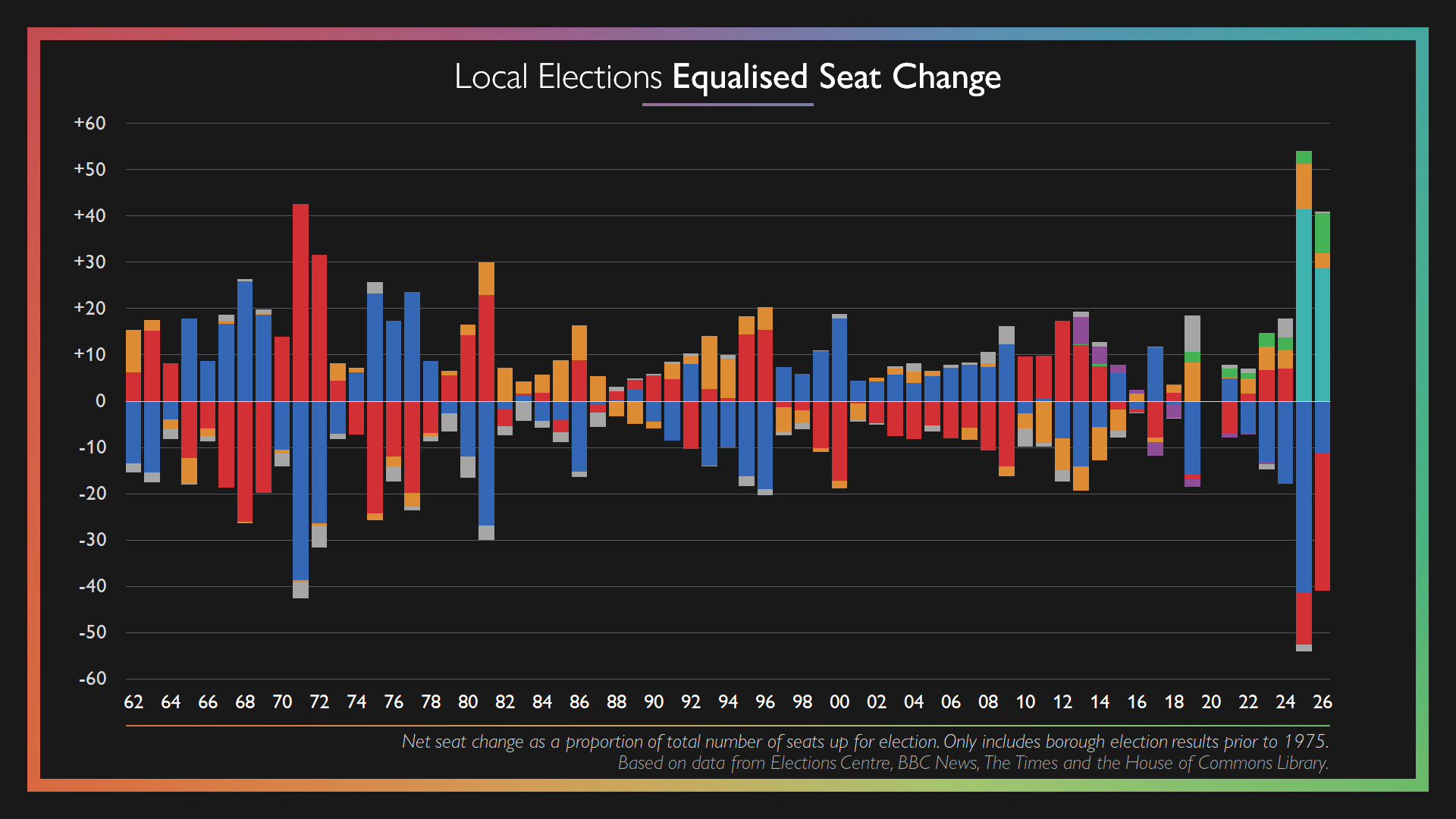
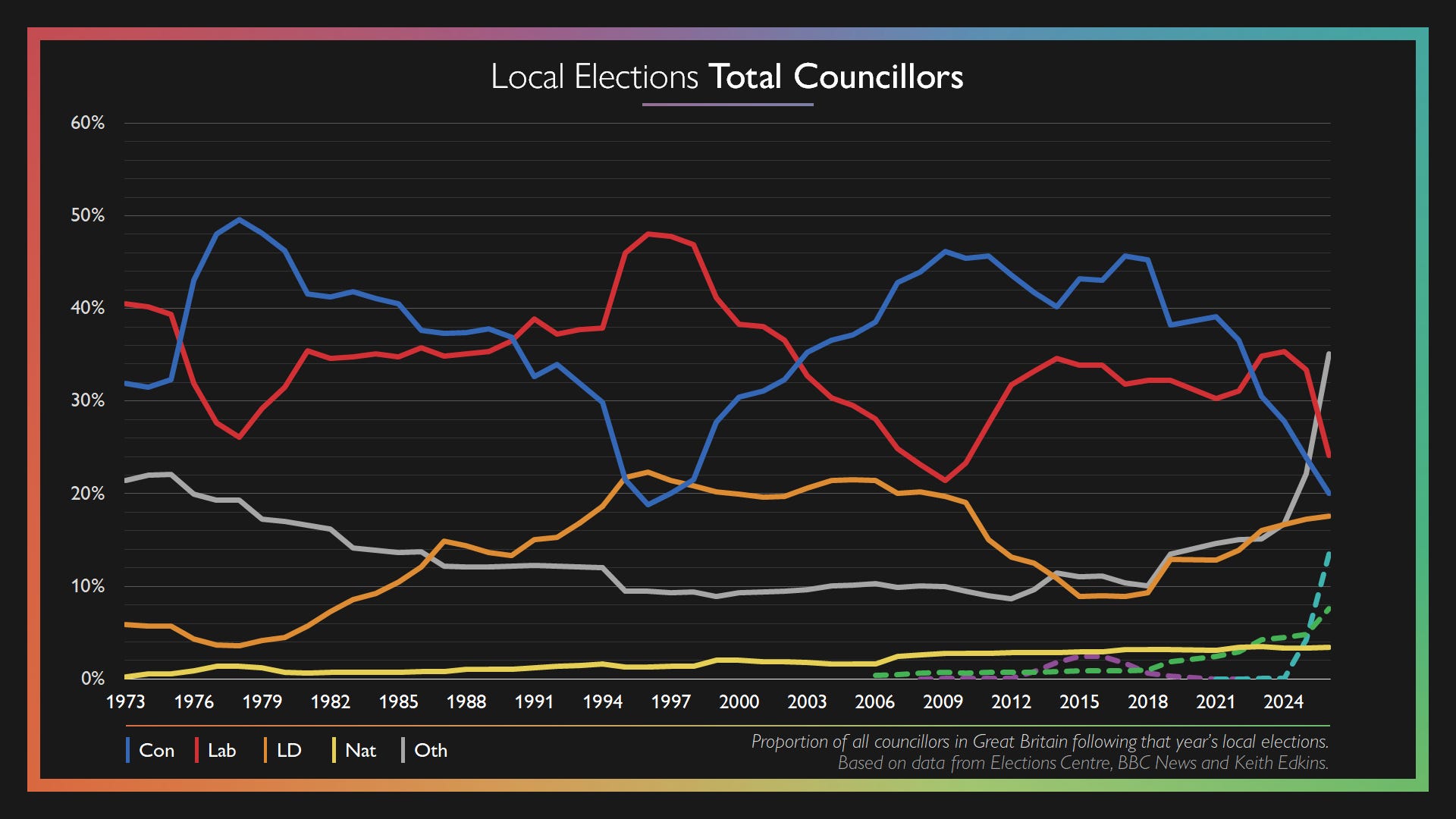
These 1,496 losses amounted to 30% of all seats up for election this year, the worst overall seat change figure for Labour in living memory, worse even than the routs experienced by the Wilson government in the 1960s. The party now holds just 24% of councillors in Britain, a level only reached in living memory by Labour between 2008 and 2011. Support has fallen to its lowest levels in a century, with a projected share of just 17%, not just Labour’s nadir, but a low-point for any government. Analysis suggests this collapse in vote share is more proportional than uniform, meaning the decline is greater in areas of previous strength, similar to that experienced by the Tories at the last general election.
Councils imagined as deepest red have turned teal, including metropolitan boroughs like Barnsley, Gateshead, Sunderland and Wakefield that have returned Labour majorities since their creation in the 1970s, with predecessor councils in some cases having even survived Labour’s late-1960s catastrophes. In other places, like Knowsley, Manchester, Salford and Wigan, such a fate was only prevented by the system of election ‘by thirds’, with such councils otherwise having fallen to Reform, the Greens or No Overall Control.
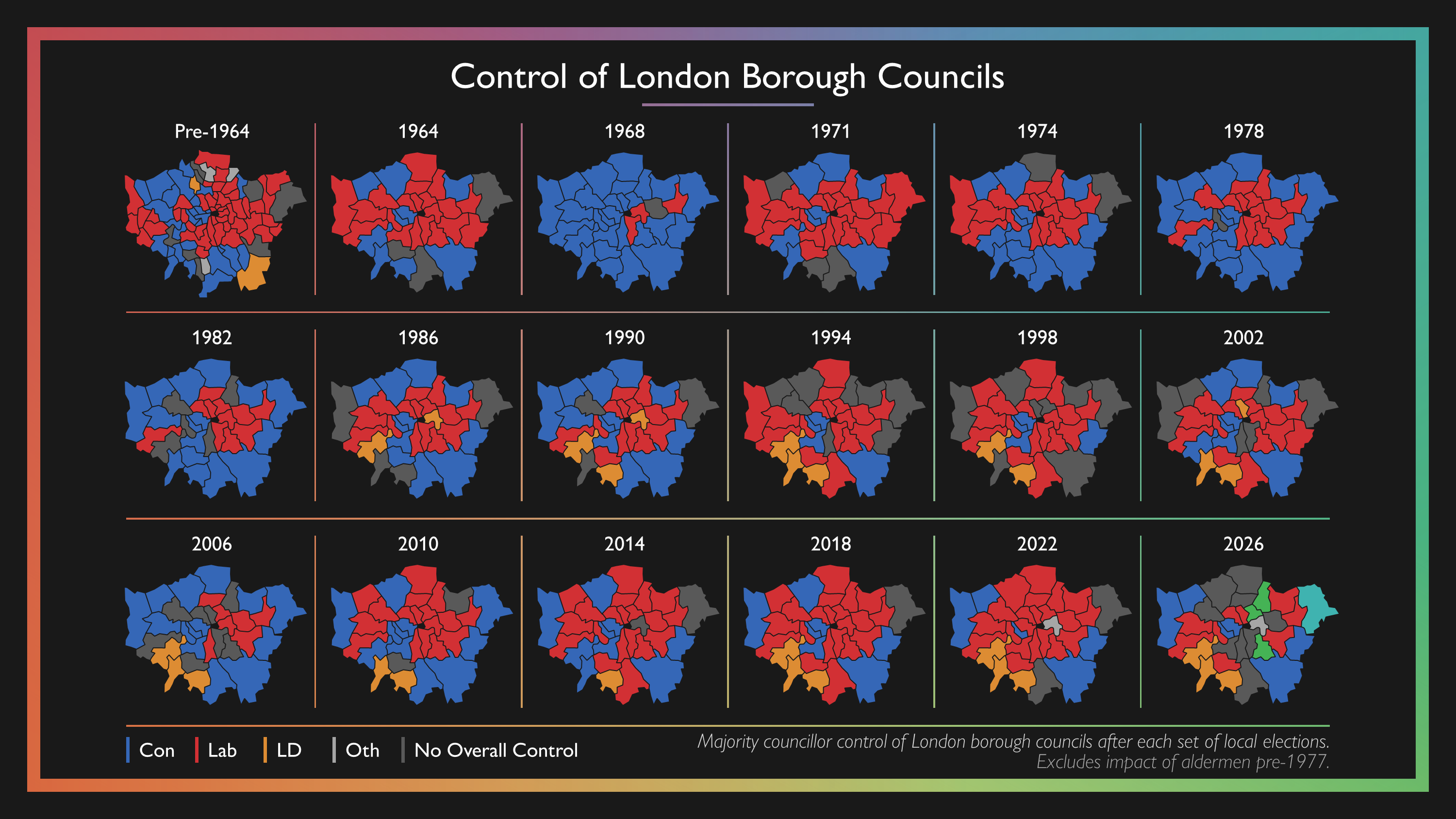
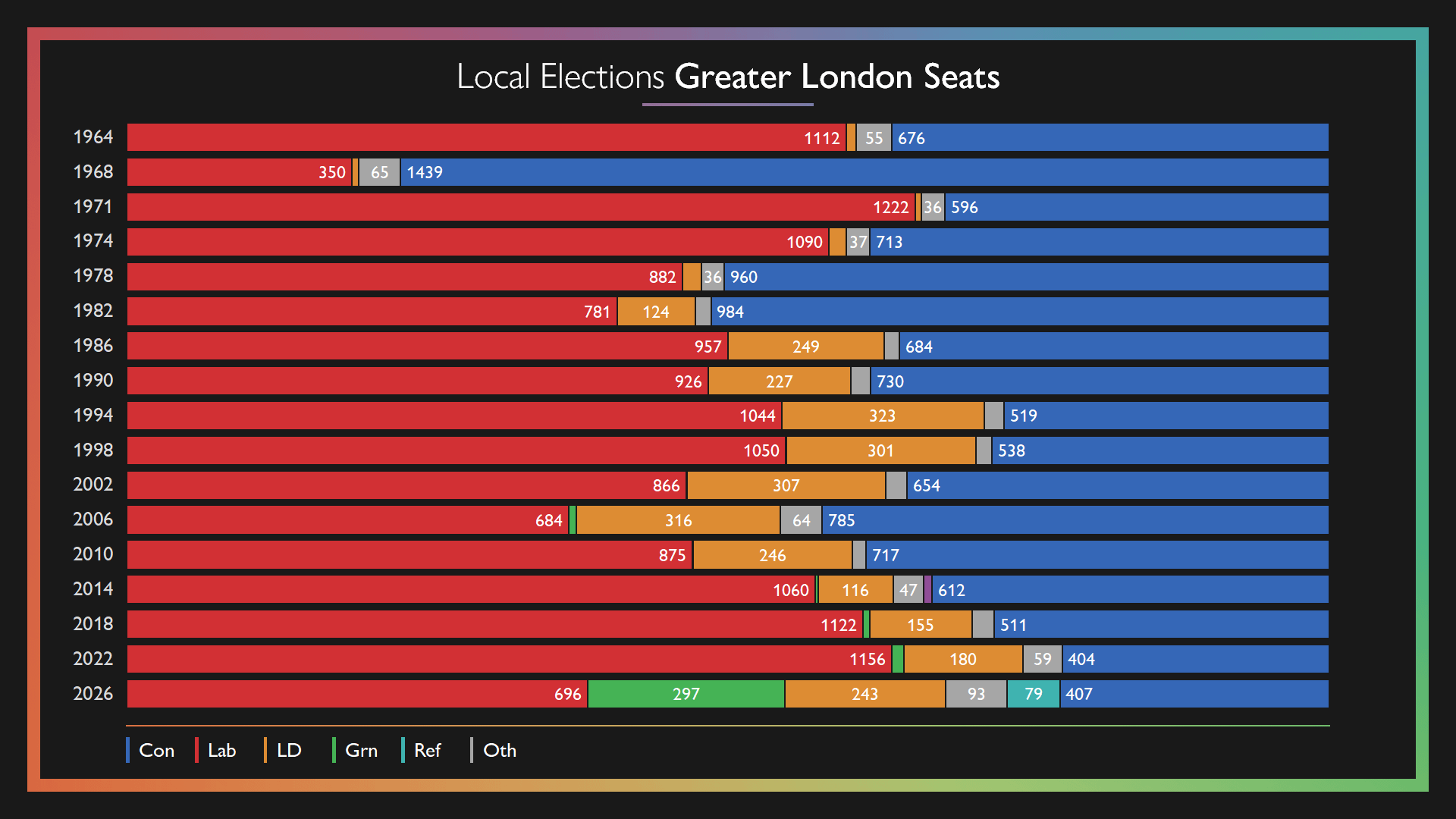
In London, where councils are elected ‘all out’, Labour held up a bit better, retaining control of nine councils outright, avoiding its nightmare scenarios of repeating their results in 2006 (majority control of just seven boroughs) or 1968 (majorities on just three). Nonetheless, this is down sharply from the 21 majorities they won in 2022, with the Greens making substantial advances in some of Labour’s inner London strongholds that they have typically dominated since the early 20th century.
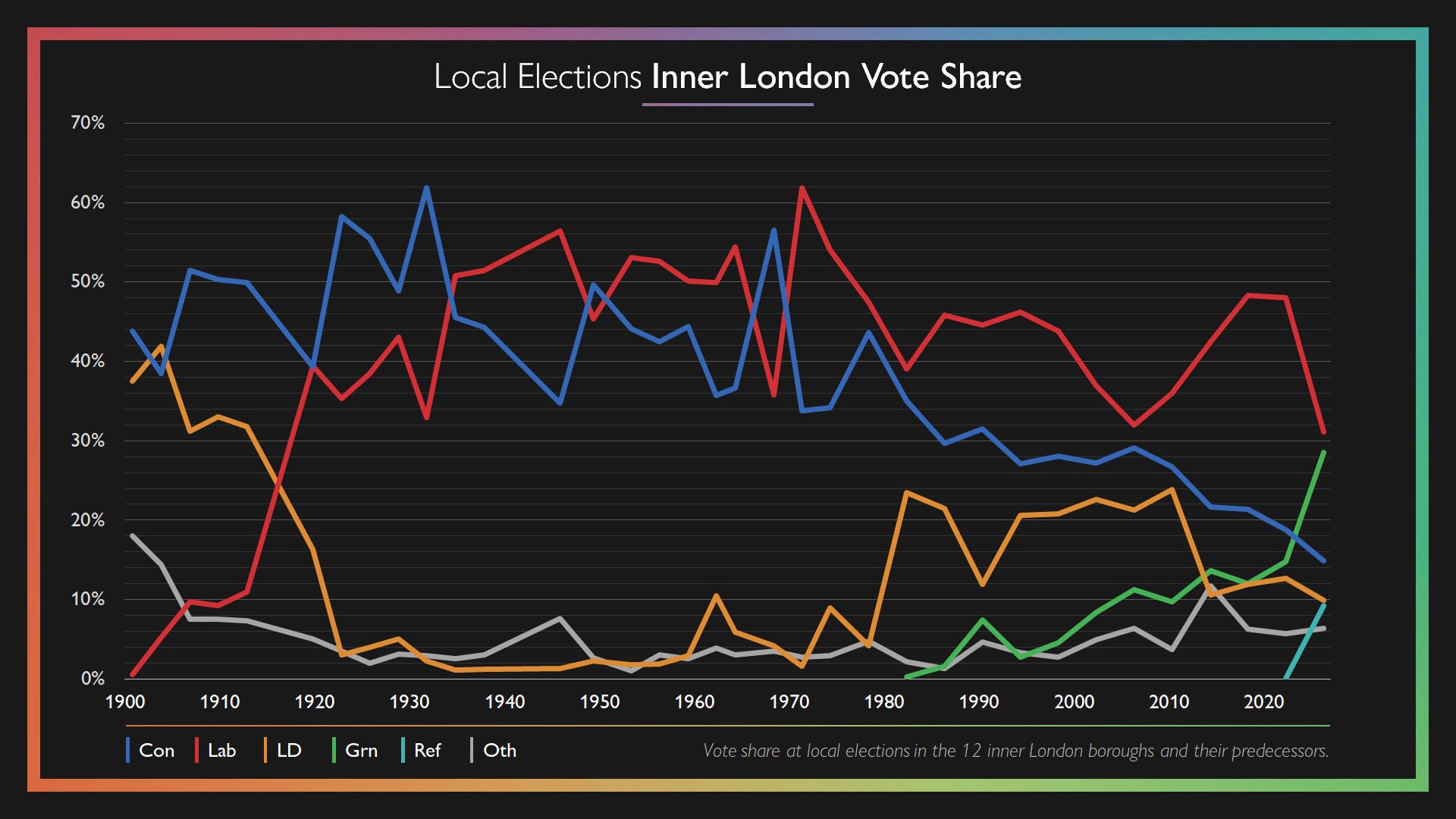
Indeed, such is the scale of their ravaging in the metropolis, that in the 12 inner London boroughs, Labour has fallen to its lowest council vote share since 1912, prior to its supplanting of the Liberals as the main party of the left. The Greens nearly drew level with this share, taking 28% of the vote in inner London, relative to Labour taking 31%, just below the 32% they won in 2006 and the 33% they fell to in 1931. The Conservatives, though, have never scored lower in these boroughs than they did on Thursday (15%).
While some will cling to the fact that it’s the norm for first-term governments to lose the high watermark council seats gained in the last years of opposition, these losses are so much deeper than this (Blair lost an average of 20% in his first term, while Cameron lost 16%). Plus, it is neglected that Labour didn’t actually get that high in opposition under Starmer. They peaked at just 35% of councillors in 2024, relative to 46% for the Tories in 2009, 48% for Labour in 1996 and 50% for Thatcher in 1978. Though there were some impressive targeted gains underneath, there was much less of a high watermark to wash away.
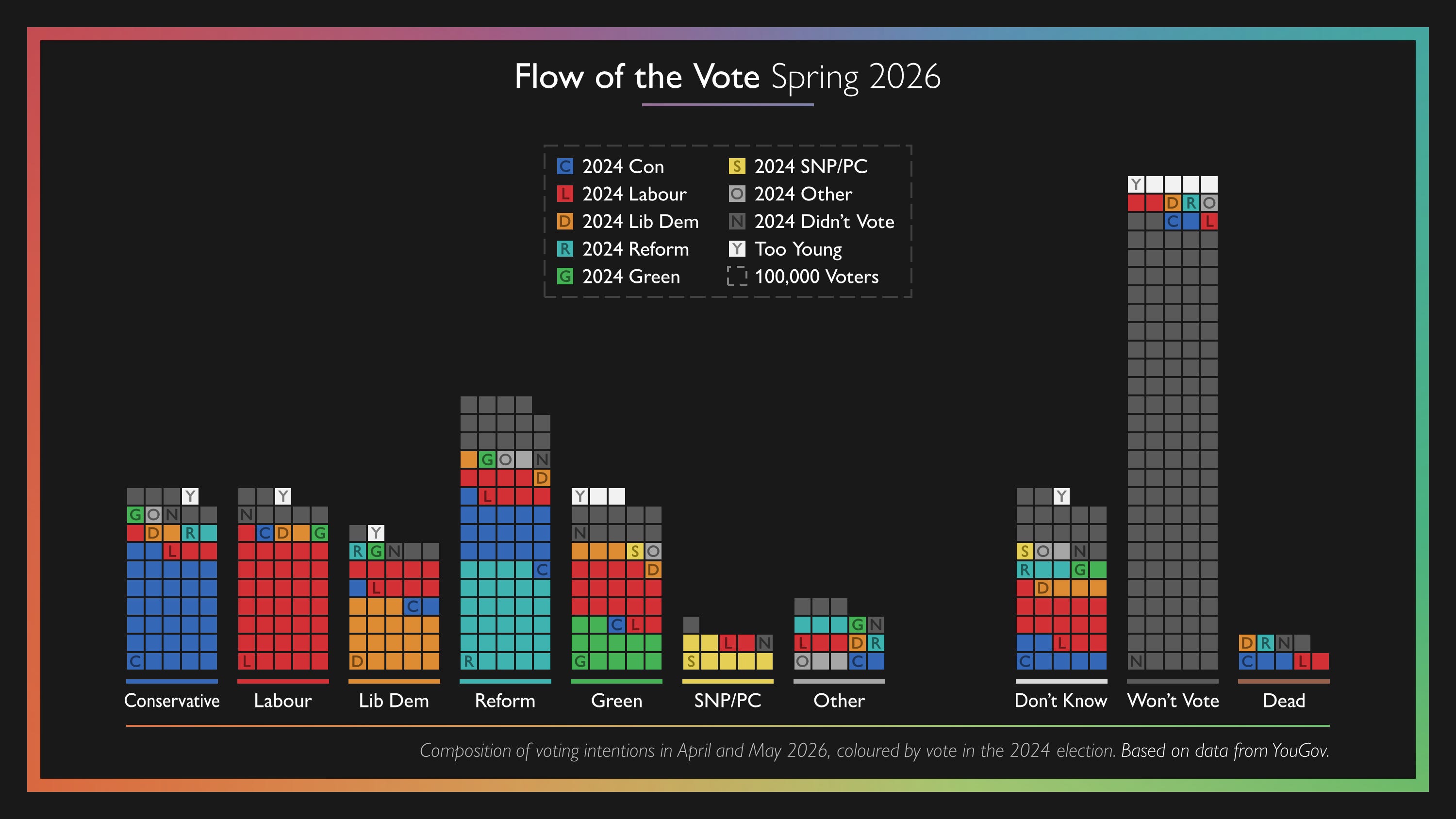
So why are the losses severe? As it’s a full essay by itself, much of which I’ve covered before, I don’t want to get into too much depth, but there are some core reasons. Mechanically, it’s because the fragile 2024 Labour coalition has fragmented in various directions. The largest source of defection is to the Greens, who a fifth of 2024 Labour voters with a preference now back, ahead of the Lib Dems (12%), Reform (10%) and the Conservatives (6%). This is a well-established trend in our polling, which has also been borne out in these council election results.
There is some variation in these proportions. The rate of defections to Reform is roughly twice the national figure in parts of the ‘red wall’, as well as being above average in Scotland (a feature of 2024 Labour voters there being disproportionately 2019 Tory voters, one of the strongest indicators of a Lab to Ref movement). There’s less regional variation in the rate of defections to the Greens, but in Wales, as many as 40% of Labour voters who voted on Thursday switched to Plaid Cymru.
Beyond those with an idea of who they’d back, 2024 Labour voters are particularly likely to say they are unsure (13%), though this rate has fallen a little in recent months, or that they won’t vote again (3%). These groups are particularly likely to not bother voting in local elections, so this will – to a small degree – have accentuated Labour’s losses this week. In all, less than four in ten 2024 Labour voters are still loyal to the party.
The reasoning for these movements is varied, as would be expected by such a splintering, but there are common factors across the coalition, which can be summed up by them feeling that what they voted for isn’t what they’ve got. They were promised improvements in public services, they haven’t got them; they were told the cost of living would get better, it hasn’t; they voted for a campaign entitled ‘change’, to be told in one of Starmer’s first speeches that things would be getting worse; they were angry at the corruption and scandal of the last government, that’s continued; they were promised competent, sensible government, they feel it hasn’t materialised.
Specific issues, like the winter fuel payments, often get raised, and Keir Starmer himself is particularly unpopular, often getting the ‘full house’ of negative qualities for a politician, with majorities of the public seeing him as weak, unprincipled, untrustworthy, dislikeable, indecisive, incompetent, and out of touch. Values questions do also matter, but cannot always be reconciled across the coalition, with the rhetoric on issues like immigration that Labour hopes will win back losses to Reform being a factor in what is driving other voters to the Greens, Lib Dems and Plaid Cymru. Those who’ve defected to Reform now outright hate Labour, and it’s getting that way among those who’ve switched to the Greens too.
How did Reform UK do at the 2026 local elections?
Another year, another set of substantial gains for Reform UK, who won 29% of the seats up for election from a standing start, producing the fourth highest seat change of any party at local elections in living memory. Overall, with more than 60% of council seats still to be elected in this local election cycle, the party already has 14% of all councillors in Britain, nearly six times that of UKIP’s peak after a full cycle. Reform is a different beast to anything that has come before it, being more than on track to supplant the Conservatives as the largest party of the right, which they are currently set to do in local government next year by a clear margin, having completed the task at Holyrood and Cardiff Bay.
The party has taken hold of yet more age-old Conservative councils and gained majorities in authorities that have been under Labour’s control since their creation, although – once again – beware the ecological fallacy in assuming that voters necessarily switch in the same way as seats. Ten of the 36 metropolitan boroughs now have Reform majorities, a feat the Conservatives haven’t achieved since the 1970s. Owing to the system of electing most of these seats ‘by thirds’, this is truthfully an undercount of the party’s strength in these areas, with many more boroughs likely to turn teal next May.
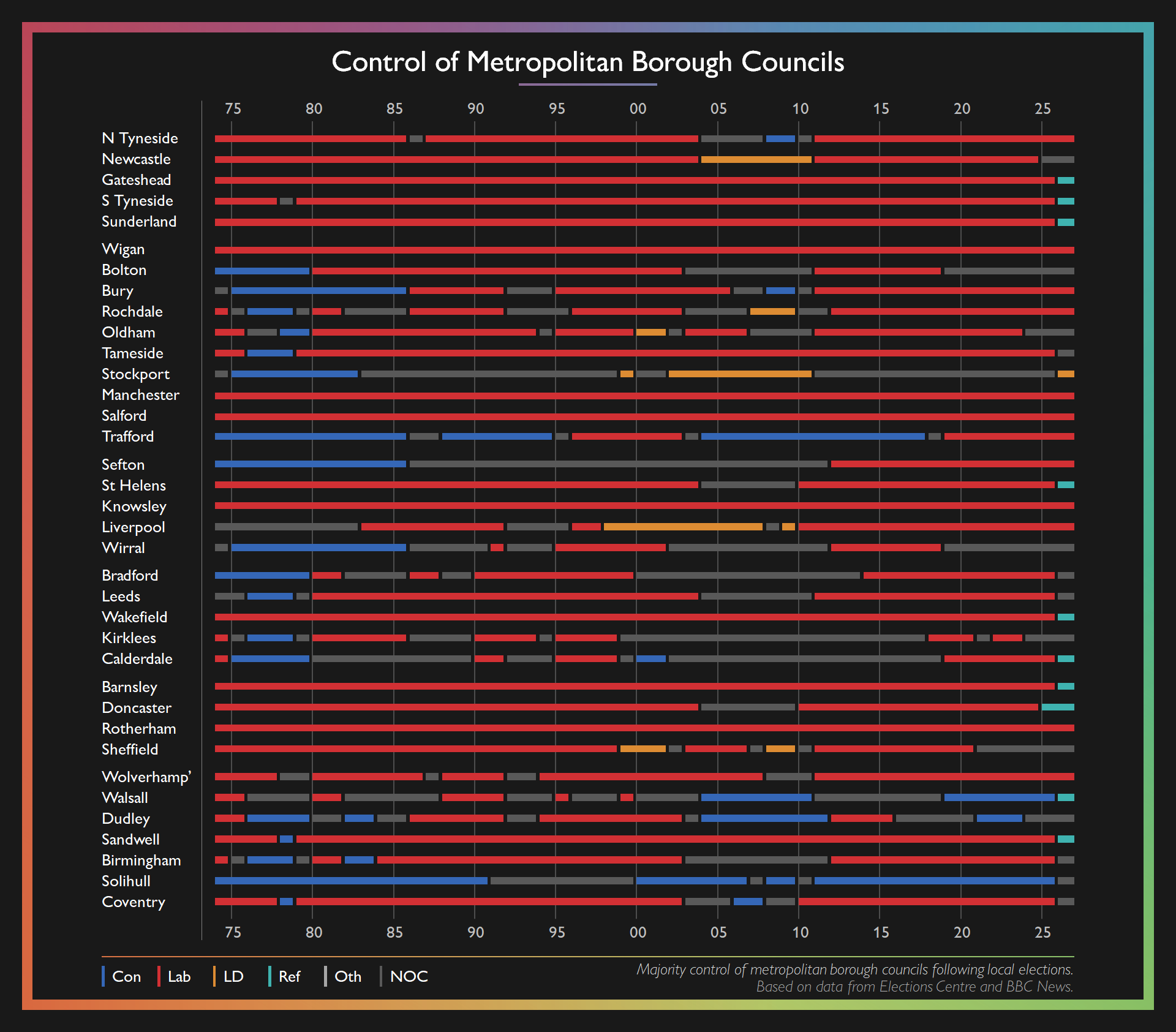
Undeniably, these results are a huge success in their own terms, but there are question marks as to whether they suggest Reform could plausibly win a majority at a general election. Sure, the party is winning by huge margins in places like Barnsley, Essex and Sunderland, but these are Reform’s baseline territories, like Bristol or Brighton for the Greens. In the majority markers I laid out last month, it’s something of a mixed bag. They did narrowly win the highest vote share in some of these areas, such as Bury, Colchester, Rushmoor and Worthing, even if they didn’t always convert this to winning the most seats. But they also fell short in areas they would need to win, like Barking and Dagenham, Bromley, Huntingdonshire and Swindon. Plus, in all these areas, it’s just very unlikely an identical result would be replicated in a general election, even given the current states of the parties.
Take Colchester, which was Reform’s 327th highest vote share in 2024. In the wards that are contained in the constituency, Reform won 26% of the vote, narrowly ahead of the Lib Dems on 24%, with other parties on 14-18%. But there’s long been a degree of tactical sorting within the wards between Labour, the Lib Dems and the Greens. Without going down the road of combined vote share, just the highest in each ward adds to 32% of the vote. Similar is true in other areas of a similar Reform pedigree. Ultimately, once you’ve kicked the tyres and considered the various factors from differing voting patterns to potential for tactical voting to turnout differential, Reform currently look to be in very good shape in most of the Brexit-iest third of the country, which would get them to the low 200s in terms of MPs and likely leave them as the largest party. But in the next 100 seats, the ones needed to get them to a majority, it looks much, much shakier without a further increase in Reform support.
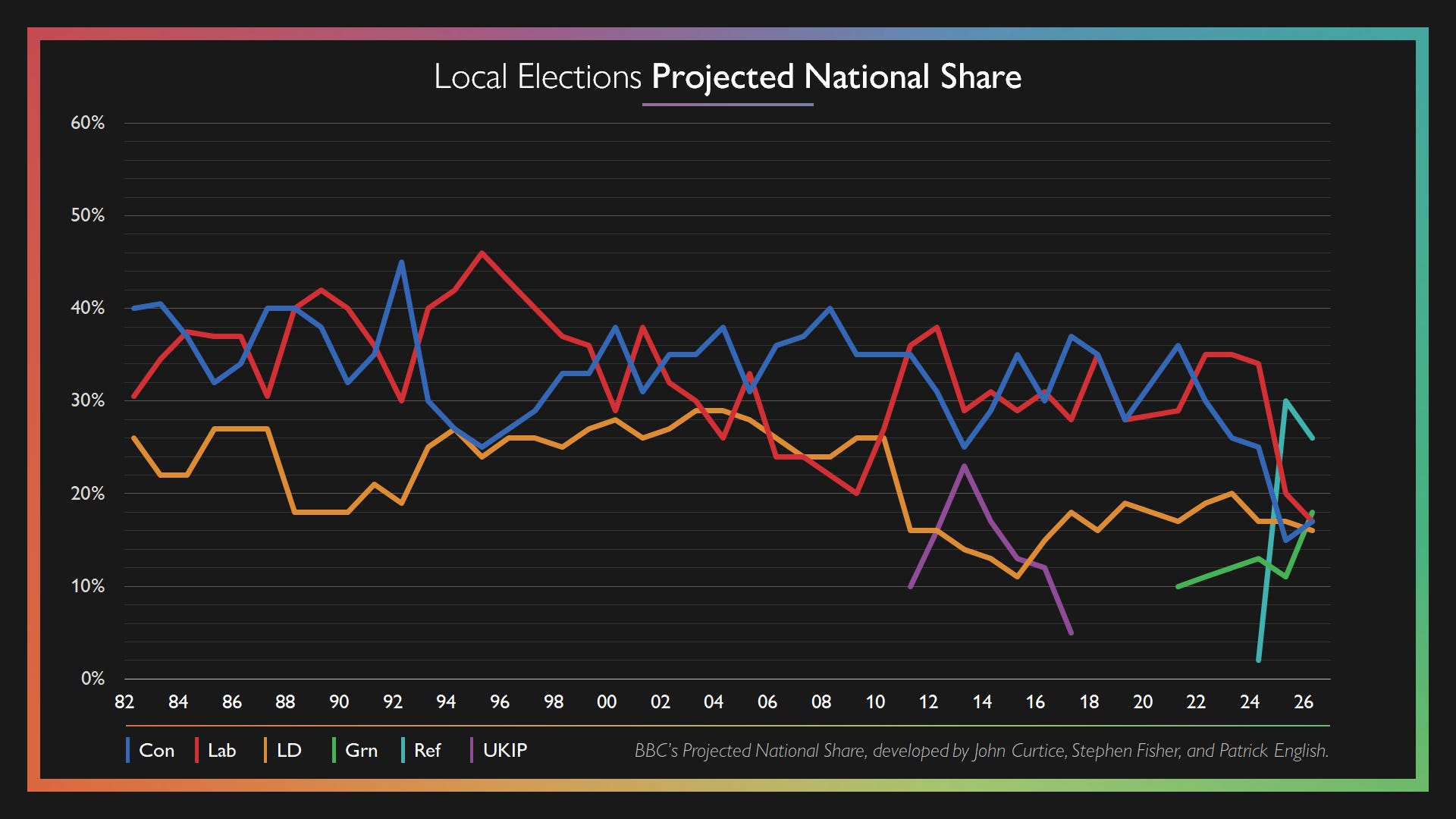
How Reform’s support is changing is one of the big questions. Projected shares showed significant declines in their vote relative to last year, with the party down about four points to 26%, at the lower end of their recent Westminster polling, in contrast to them outperforming such polls last year. Some of this is likely to be down to a reduction in the turnout differential, with last year’s shares being boosted by as much as two points by Reform supporters being particularly likely to vote. Turnout has been relatively healthy this year, reflecting trends in recent bipolarised by-elections, though further study and BES data will be needed to confirm the exact causes of any changes.
One other point of difference for which we’ll need further study is the emergence of Restore Britain, who have won over a small chunk of Reform voters in recent polls, yielding total support of about 2-4%. But given Restore didn’t field candidates beyond Great Yarmouth, the fact Reform are still lining up with polls could indicate that Restore voters are not willing to return home or that they are and that other factors are now working against a combined radical right vote.
While there has been some hope on the left that Reform-run councils would expose the ‘realities’ of the party to their voters, comparing areas that had elections this year and last does not show any consistent impact, and certainly no significant negative impact, on Reform support. Indeed, it has even risen in some areas, including by as much as five points in Burnley, though dropping is more common, including by four points in Huntingdonshire and as much as six points in Newcastle-under-Lyme.
How did the Greens do at the 2026 local elections?
Following record polling in recent months and their by-election gain in Gorton and Denton, the Greens also enjoyed their best-ever local election results on every major metric. Although not quite on the scale of Reform’s gains, the Greens took 12% of seats up for election, an increase of nine points, the seventh best seat change by a party other than the Conservatives or Labour in the post-war period, larger than UKIP’s breakthrough in 2013 (6pts) and on a par with the Liberal wave in the aftermath of the 1962 Orpington by-election (9pts). Their projected vote shares also reached new heights, up to 18% with the BBC’s PNS measure. Across everything I suggested the Greens would need to do to prove their polling wasn’t a mirage, they did.
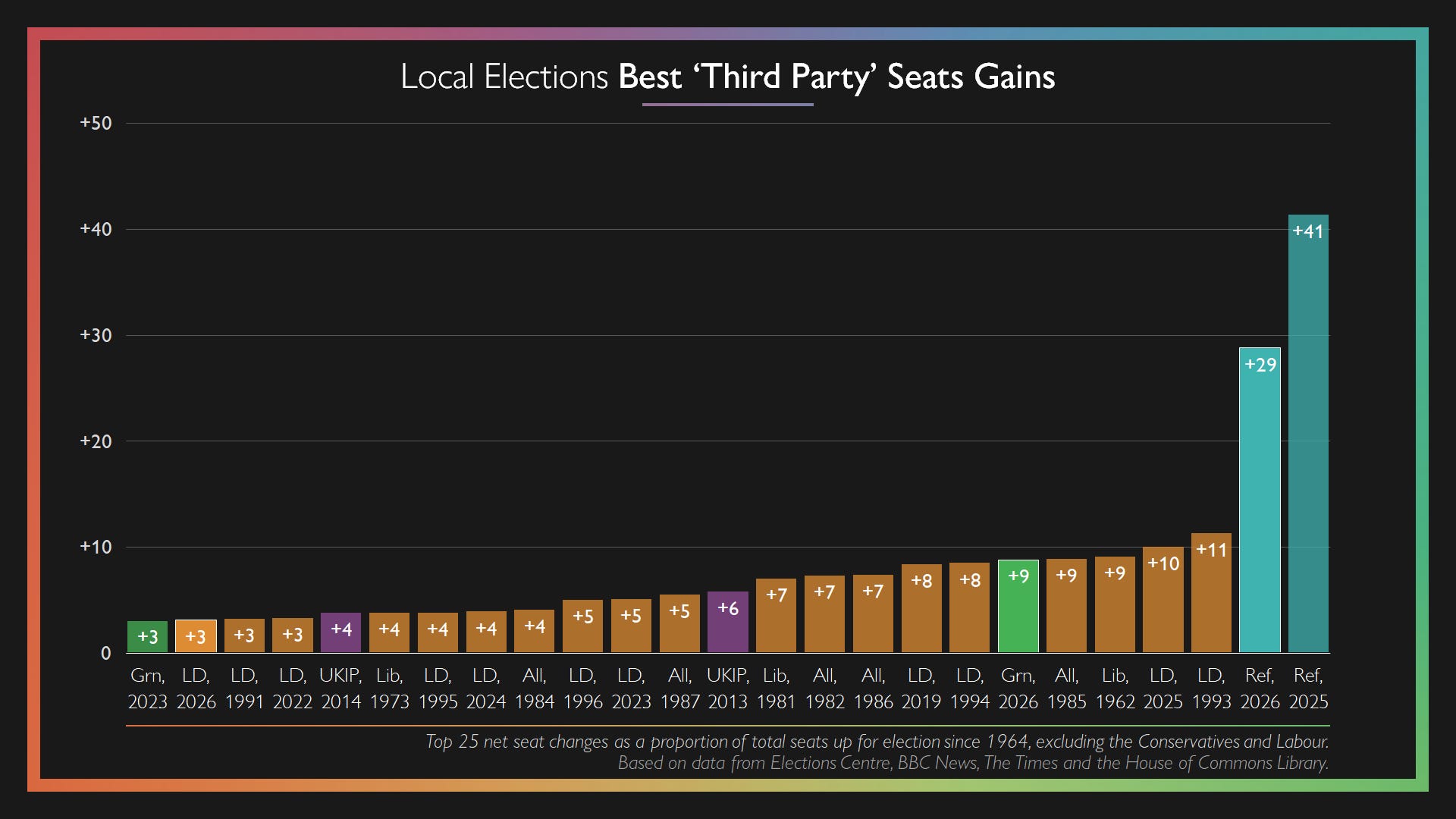
Though their breadth of support is not yet enough to supplant Labour as the largest party of the left, the results do suggest the Greens now have a reasonable chance of winning in at least 10% of parliamentary constituencies. Most of these are indeed inner city seats and/or studenty areas, with the Greens topping the poll in multiple London boroughs, Cambridge, Exeter, Manchester, Norwich, Oxford and Reading, in a manner not that unlike the Lib Dems in the mid-2000s. And, of course, the Greens’ ability to directly deprive Labour of seats is not the only threat they pose to the government, a significant proportion of Labour’s seat losses to Reform will be attributable solely to Labour voters defecting to the Greens.
There are also green shoots elsewhere, with the party taking majority control in Hastings, as well as putting in respectable vote shares in places like Trafford and Worthing, as well as much of West Yorkshire. The party also expanded their patches in rural Suffolk and Sussex in the county council contests, though in some of the seats they were defending, there were small declines in their vote, with stagnant shifts in neighbouring wards. Given the shortage of such areas in this year’s locals, it’s perhaps too early to tell how much of this is down to a reversion after ‘above average’ gains in previous years, how much is down to Green’s national support catching up with their potential support that had already been reached in these targeted areas, and how much is down to Zack Polanski’s message being more aimed at the party’s urban base.
How did the Conservatives do at the 2026 local elections?
While the Conservative leadership seem to have decided that the elections went well, suggesting they have entered their third year of detachment from electoral reality, there is no real way of looking at the party’s losses as anything short of appalling. I would say this is a party attempting to convince people that 2+2=5, but a) I think that is actually just the state of maths in the Tories today, and b) they aren’t really able to convince anyone of anything right now.
First-term oppositions have practically always been able to make ‘rebound gains’, simply because governments tend to start losing pretty ‘safe’ seats in their final years in power that are easy to pick back up on the other side and give an illusion of momentum. Ed Miliband managed this, William Hague managed this, even Michael Foot managed it one year. Kemi Badenoch, though, has now overseen the two worst results on most metrics for a primary opposition party in living memory. And it’s not really that close. Prior to last May, the worst opposition performance over the last sixty years was Labour in 2017, when Jeremy Corbyn oversaw the party losing 25% of the seats it was defending. Last year, the Tories lost 68% of their defences, this year they lost 41%. This is a level more akin to the Lib Dems during the coalition (average 39% loss) and governments before they lose general elections than it is for first-term oppositions, who on average expand their councillor base by about 50%.
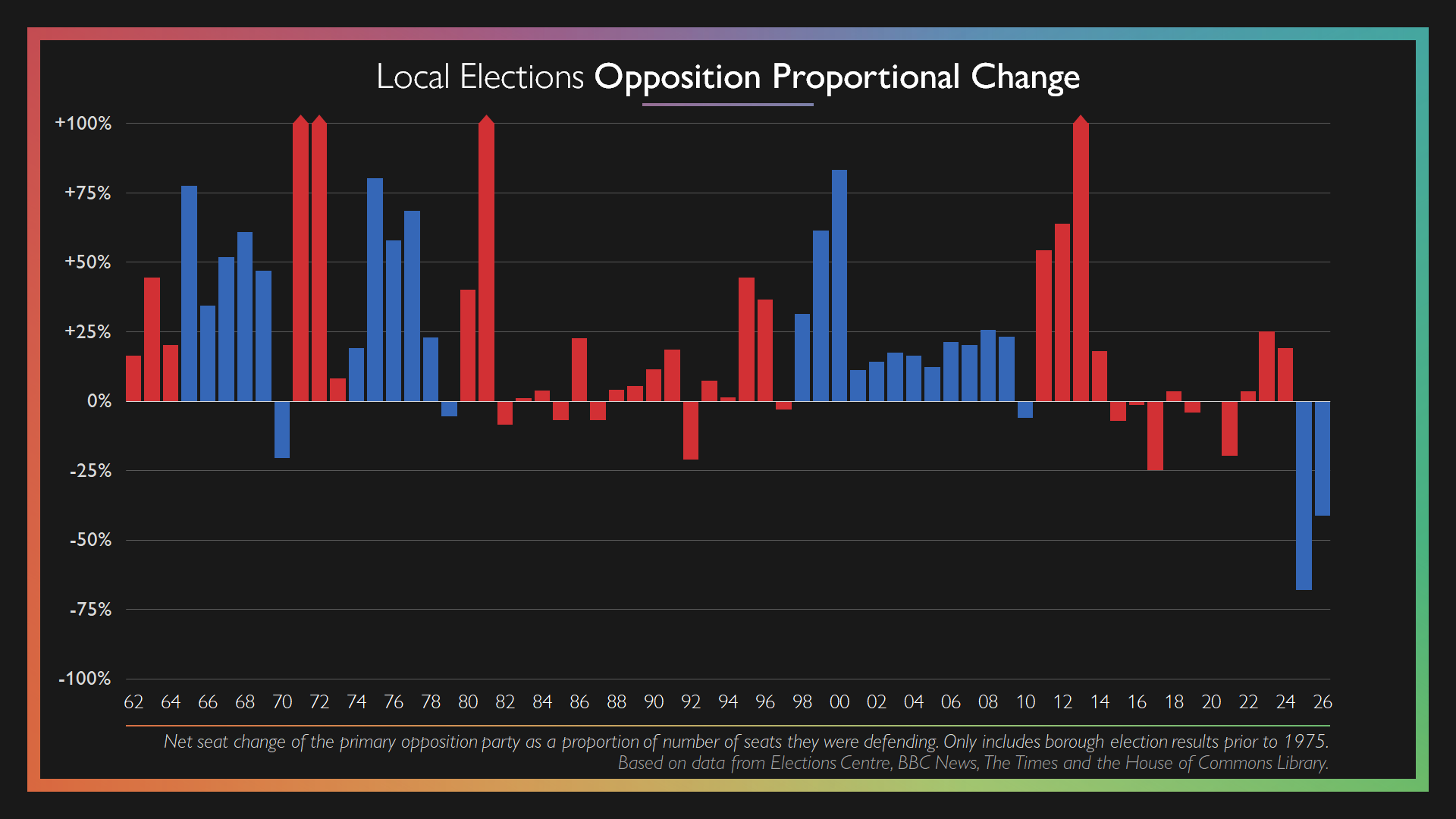
Sure, 41% is less than 68%, and I can already hear some wanting to paint this as progress. But this forgets the key rule of local election analysis: remember your baselines. Last year’s elections were seats that had been previously contested in 2021 when Tory support was roughly ten points higher than in 2022, when most of this year’s seats were last fought. Looking like-for-like at results from 2025 and 2026 suggests little-to-no progress actually being made, something also borne out in the projected shares, which both show Tory support up just two points relative to their worst-ever levels last year. In some areas which had county elections last year and district elections this year, the Conservative vote has actually fallen significantly, including six point drops in Burnley and Redditch, and a seven point decrease in Cherwell. Even if you want to be optimistic, this is a sharp downward trend being marginally slowed, not stopped and certainly not reversed.
This is a party retreating to the few ecological niches which no other party can reach at present, with these primarily being older wealthy professionals, older traditionalist ‘village green’ CofE types, and often older members of certain minority groups like Hindus. Under First Past the Post, this is probably enough to survive in the medium-term, but not much more than that. It’s giving a fair bit of ‘Liberals in the mid-20th century’ vibes, just with the remaining patches being in parts of the rural south and some London boroughs, rather than the Celtic fringe.
There are potentially some glimmers of, maybe not hope, but a more successful strategy. Local parties in some areas, such as Hampshire and south east London, centred their campaigns on an explicit anti-Reform message, aiming to encourage Labour and Lib Dem voters to lend them their vote to “stop Reform”. Results in these areas do seem to have been a little better for the party than those in areas where literature had a tone more similar to the national party, though this might simply be because these were areas where Reform were less likely to siphon off Tory votes to begin with.
How did the Lib Dems do at the 2026 local elections?
The Liberal Democrats’ performance was the definition of ‘fine’. As with every year since 2018, the party has made net gains in councillors, though this year’s increase was somewhat below average: their gains represent an additional 22% on top of the seats they were defending, relative to an average of 43% over this period and an increase of 79% last year.
In part, this is because the Lib Dems’ main strategy of recent years – to become the party of Waitrose suburbia – has largely been accomplished. Ed Davey can weep for there are no more Remain-voting Tory councils to conquer; the Lib Dems have won here and have returned their overall level of councillors to just shy of their pre-coalition level (18% today vs 19% in 2010). In future years, the party’s strategy is presumably going to become more defensive, as they look to consolidate their gains, though given the Conservatives’ seeming lack of interest in winning back these areas, this might not be the biggest challenge.
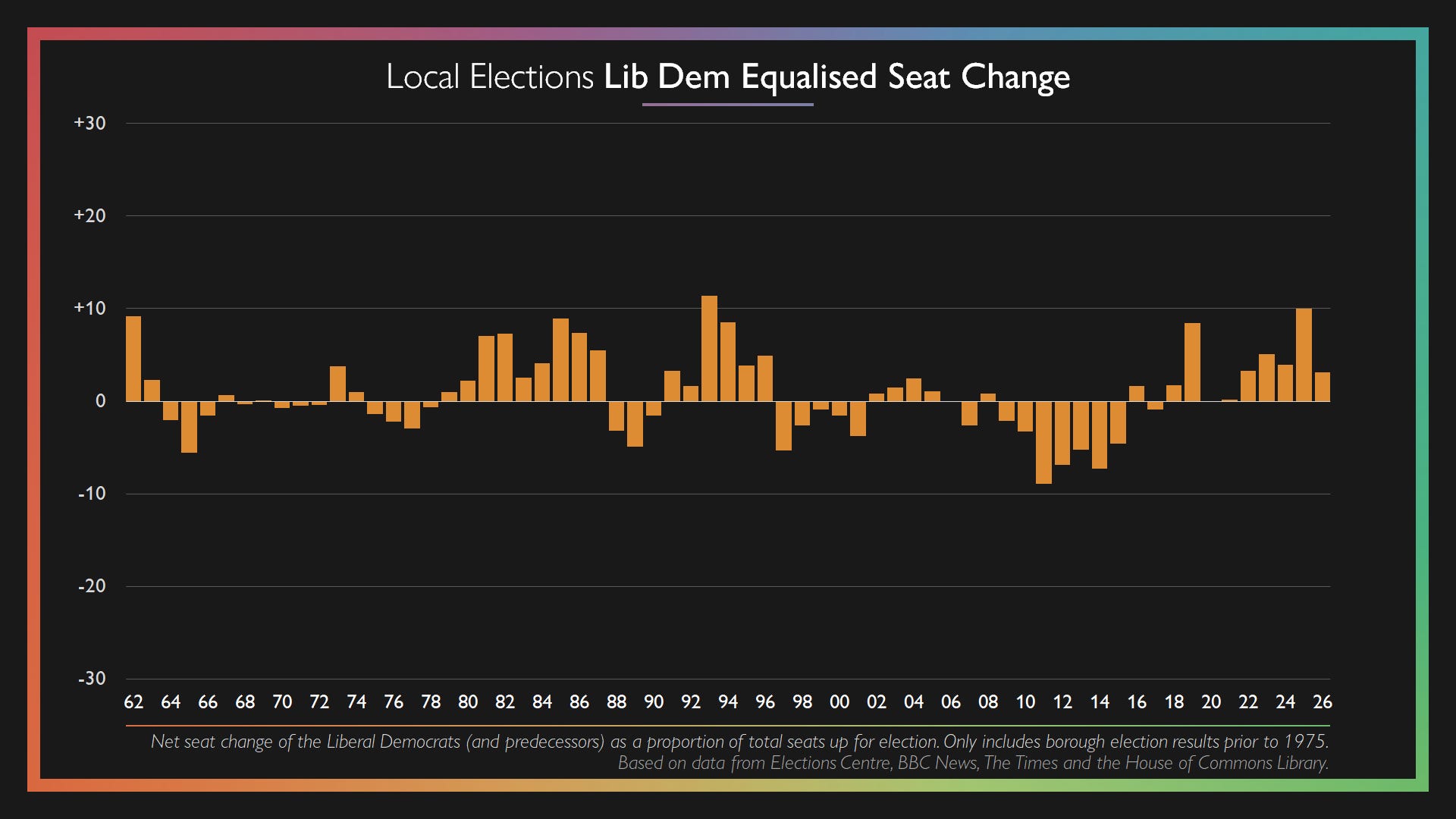
But while they may have gained Stockport and the two new Surrey authorities, as well as increased some majorities elsewhere, the party does look to have struggled in more Leave-voting areas, losing all their defences in Gosport and their majority in Hull, as well as in some urban areas, with the party recording its lowest vote share in the inner London boroughs since 1978. The Lib Dems additionally fell back slightly in Three Rivers and West Oxfordshire, both of which were key targets for gaining overall control. Alongside their projected share dipping a little over the last few years, these results will do nothing to quell internal concerns that the party has stalled.
This article was corrected on 11th May to state Labour kept hold of nine councils in London instead of eight, as Redbridge has incorrectly been categorised as NOC in the map. Thanks to adamkmd.bsky.social for noticiting.
That inner London figure is really important - Labour falling to its lowest council vote share in inner London since 1912, with the Greens taking 28% against Labour's 31%. The psephological implication is clear but the economic one less discussed: inner London constituencies are disproportionately held by Labour MPs on large majorities who are now watching their local base collapse to the Greens. Those MPs will face a binary choice at the next election - move left to shore up the Green flank, or hold the centre and lose the seat. That intra-party pressure is what makes any new Labour leader's fiscal positioning so uncertain, and why the market can't price a clean Streeting outcome even if he wins.
Really interesting read, the next few weeks could be crucial for the future of the UK. If Starmer manages to hold on to power then the actions of the local councils in the next 3 years could play a huge role in the outcome of the next general election.